Home › Custom battery pack
Custom batteries
Custom battery packs for machinery and equipment.
When no catalog pack fits in the machine, can handle the duty cycle or meets the target cost, we design yours: architecture, mechanical design, BMS, power distribution, integration and testing.
At a glance
A custom battery pack is a battery designed for a specific machine: its capacity, voltage, shape and management (BMS) are sized from real duty cycles and the space available. It includes the cells or modules, the mechanical structure, the management system, the protection devices and the connection to the machine.
- Custom lithium packs, including NMC
- Sizing based on real duty cycles
- Pack mechanical design, mounting, cooling
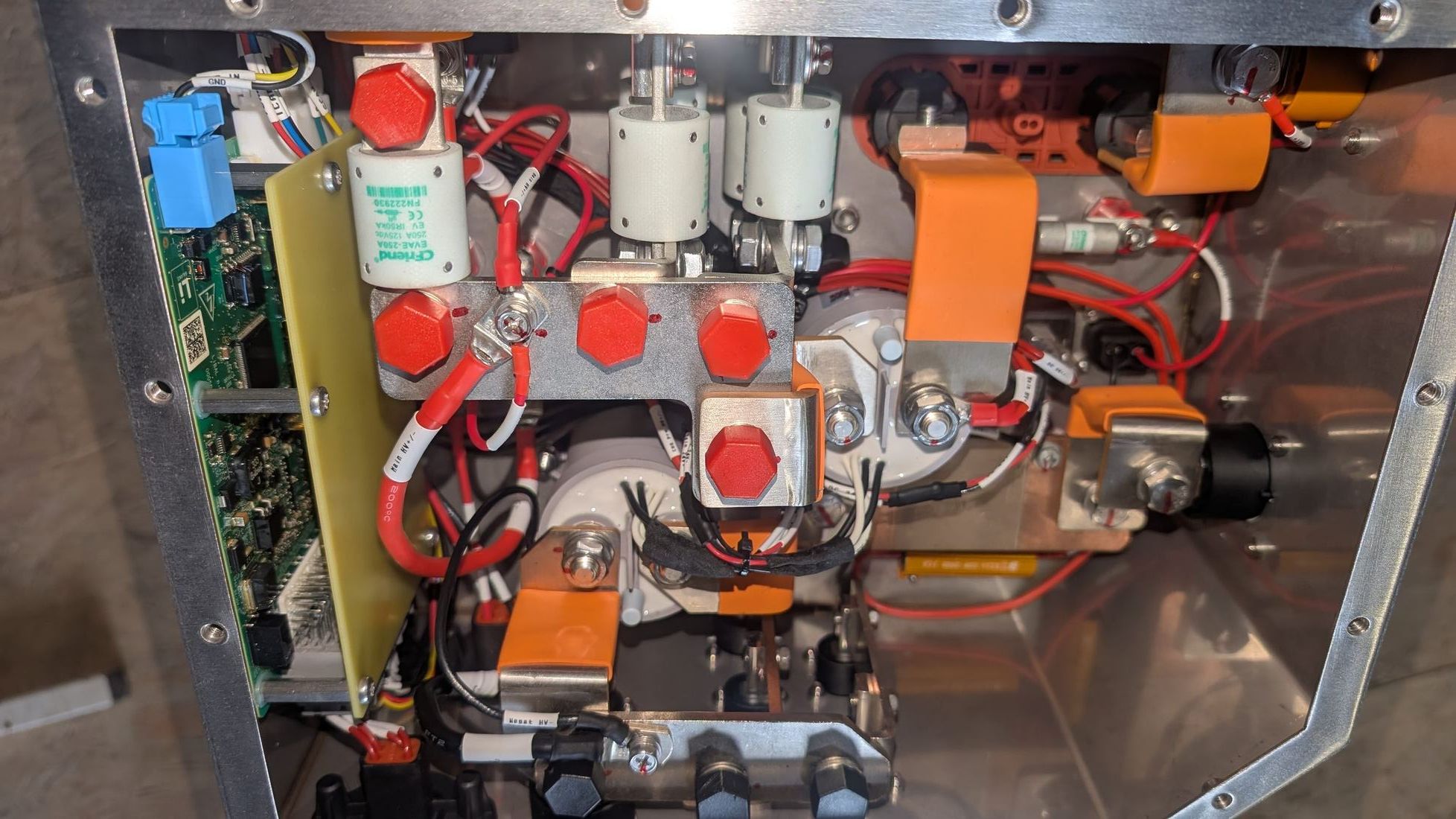
- BMS, precharge, contactors, fuses, insulation monitoring
- Power distribution (PDU) and charging
- Benchmark: TOOGO's 70 kWh NMC pack, under €150/kWh
Why a custom pack?
A standard pack dictates its shape, voltage and price. On a mobile machine, the available space is rarely a neat box, the duty cycle is specific to the application and the battery weighs heavily in the unit cost. Designing the pack together with the machine makes it possible to carry more energy in the same volume and hit the series cost target.
On TOOGO, this approach made it possible to carry 70 kWh instead of the 40 kWh in the specifications, for under €150 per kWh, with a pack designed, programmed and integrated by our teams.
What pack design involves
Sizing
Energy, power and voltage calculated from duty cycles.
Cells and modules
Choice of chemistry and modules, validated with their manufacturers.
Mechanical design
Structure, mounting, vibration resistance, cooling.
BMS and protection
Cell management, precharge, contactors, fuses, insulation.
PDU and charging
Power distribution to motors and auxiliaries, fast and slow charging.
Software
Energy management and diagnostics on the vehicle controller.
Safety and regulations
A traction battery holds a lot of energy, so its safety is addressed from the architecture stage. A precharge sequence before the main contactors close, properly sized fuses, insulation monitoring, emergency disconnect and lockout for maintenance are all part of the design, as is the pack's mechanical strength on a machine that vibrates and takes impacts.
Transporting lithium batteries and placing them on the market are regulated, notably by UN 38.3 testing for transport and by Regulation (EU) 2023/1542 concerning batteries. We identify the requirements that apply to your pack from the feasibility study onward.
From duty cycle to tested pack
- Duty cycles: power and energy the machine actually consumes over a working day.
- Architecture: chemistry, voltage, capacity, placement in the machine.
- Design: pack CAD, electrical schematics, choice of BMS and protection devices.
- Prototype: pack assembled in our workshop.
- Integration on the machine, with the energy management software.
- Testing under real load, on test benches and then on the machine.
Reference · TOOGO
TOOGO: 70 kWh NMC pack developed for the project
TOOGO's battery pack was developed specifically for this 3-tonne, 100% electric robot. Using the same NMC chemistry as an equivalent project run in-house by a large group, it comes in at under €150/kWh. Read the TOOGO case study.
Frequently asked questions
How much does a custom battery pack cost?
It depends on the application; as a benchmark, TOOGO's NMC pack was built for under €150 per kWh of onboard energy.
NMC or LFP: which chemistry should you choose?
NMC offers higher energy density, useful when space and weight are limited; LFP is heavier for the same energy but valued for its service life and thermal stability. The choice depends on the available volume, the duty cycle and the target cost.
Do you handle the BMS?
Yes: BMS selection and configuration, precharge, contactors, protection devices and communication with the vehicle controller are all part of pack design.
Can you design a pack for an existing machine?
Yes: that is the core of electrifying a machine already in service. We start from real duty cycles and the space freed up by removing the combustion engine.
Where do the components come from?
We favor components of European origin, validated directly with their manufacturers.
Let's talk about your project.
A first 30-minute call with a technical lead, with no commitment.