Home › Prototyping and testing
Prototyping and testing
Industrial prototyping: from drawing to proven prototype.
Machining, welded fabrication, wiring, assembly, test benches and field tests: our workshop builds and tests the prototypes designed by our engineering team, or yours.
At a glance
Industrial prototyping means building a first working version of a part, subassembly or machine to validate its design before series production. It combines part fabrication (machining, welded fabrication, cutting), assembly and testing: benches, endurance and instrumented field tests.
- Prototyping workshop integrated with the engineering office
- Machining, welded fabrication, laser and waterjet cutting
- Hydraulic plumbing and electrical harnesses
- Test benches and endurance testing
- Private test ground, away from prying eyes
- Instrumented testing and test reports
Building what we design, testing what we build
A prototype is only worth something once it has been tested. Our workshop makes the parts, wires and assembles the machines, then puts them through bench tests and real-world trials on a private test ground that keeps your projects confidential.
We also run test campaigns on your own products: endurance, test benches and field tests, with instrumentation, measurements and a test report.
Resources and services
Fabrication
Machining, milling, welded fabrication, laser and waterjet cutting, rotational molding.
Assembly and wiring
Hydraulics, electrical harnesses, system integration.
Small batches
Pre-series and small-batch production.
Test benches
Testing of custom-developed components.
Endurance
Instrumented endurance test campaigns.
Field tests
Private test track in Aveyron, away from prying eyes.
Machining prototypes and one-off parts
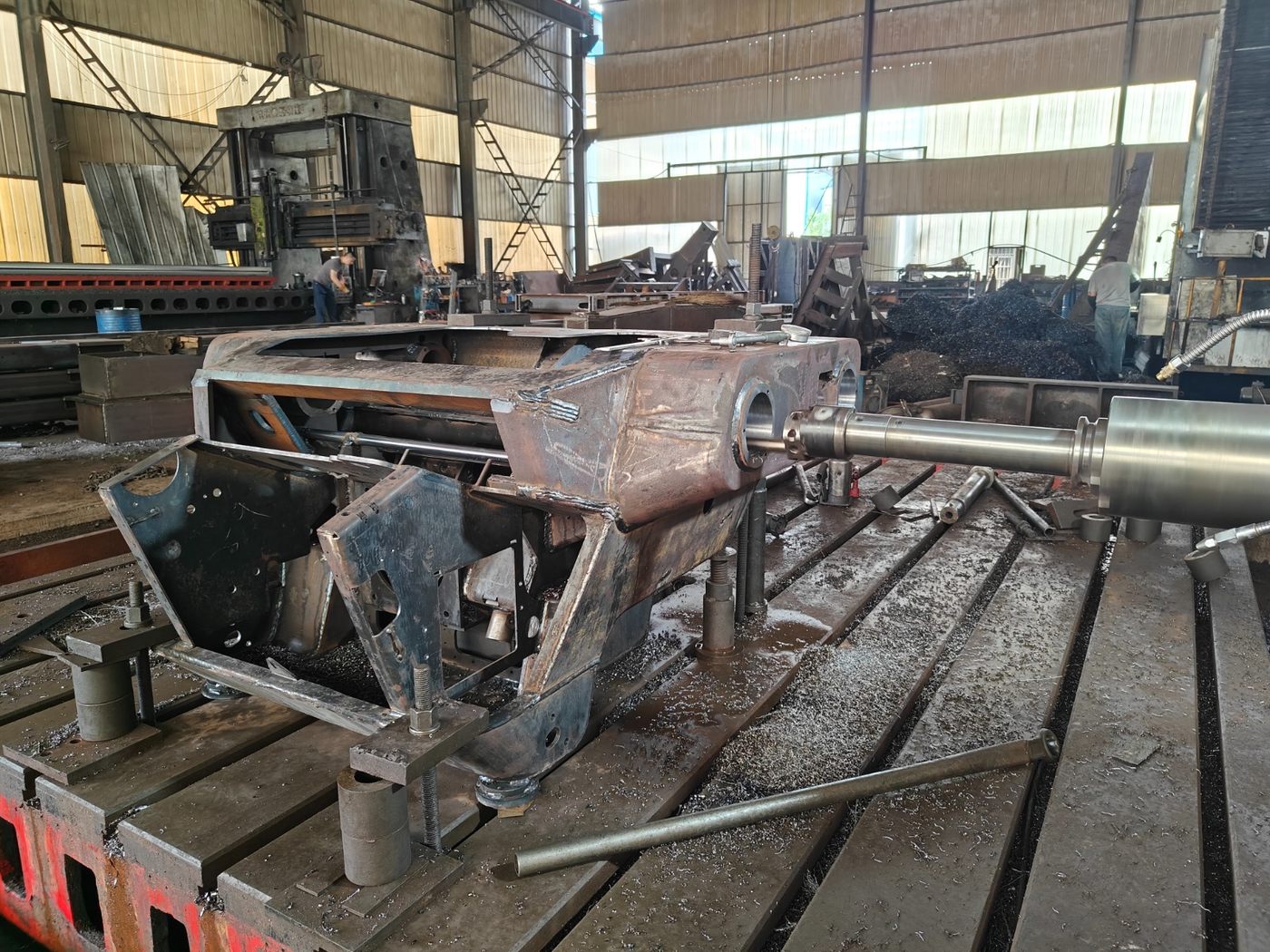
A prototype often succeeds or fails on a handful of parts: a housing, a bracket, a chassis that needs machining after welding. Our workshop machines and mills these parts as one-offs or in very small quantities, from your drawings or ours, and machines welded assemblies after welding to hold the functional dimensions: bearing surfaces, bores, interfaces.
Because the workshop sits next to the engineering office, a part that does not fit is corrected on the drawing and remade right away, which shortens iterations. For processes we do not have in-house, we rely on a network of partners in France and Europe.
Industrial machine prototypes: from single part to complete machine
- Design review: drawings checked for manufacturability, process selection, components validated with their manufacturers.
- Part fabrication: machining, welded fabrication, laser or waterjet cutting, painting.
- Assembly: mechanical, hydraulics, electrical harnesses, electronics.
- Commissioning: software and tuning right at the machine.
- Testing: benches, endurance, then real conditions on our private test ground.
- Feedback into the drawings: deviations corrected, documentation updated for pre-series.
We build prototypes of machines designed by our engineering team just as readily as prototypes from your own drawings.
How much does an industrial prototype cost?
The cost of a prototype depends less on the parts than on the number of iterations needed to get a working machine. That is why we quote each phase separately, with a decision milestone at the end of each one: you know what you are committing to before launching the next.
As a benchmark, on our TOOGO robot, the machined, welded and painted chassis, ready for assembly, costs €7.5/kg, and the complete 3-tonne machine was developed from a blank sheet to pre-series for €1.1M.
What we test and how
A useful test starts with a precise question. Does a component withstand the expected number of cycles? Does the machine reach its performance under real load? Is the software tuning stable on every type of terrain? Before starting, we agree with you on the protocol, the quantities measured and the acceptance criteria.
Tests run on benches in our workshop, then in real conditions on our private test ground. Each campaign ends with a report covering conditions, measurements, deviations found and design recommendations.
From prototype to pre-series
The prototype validates the design, and the pre-series checks that the machine can be reproduced. We build both, keeping specific jigs and tooling that drive up series costs to a minimum from the prototype stage, then produce an industrialization package that can be handed over to your teams or suppliers.
For series production, manufacturing can be entrusted to your usual suppliers, to subcontractors in the Mecanic Vallée, or carried out in the region of your choice.
Deliverables
Test protocol
Objectives, conditions, measured quantities, criteria.
Test report
Measurements, deviation analysis, recommendations.
Industrialization package
Bill of materials, process sheets, drawings, inspection points.
Reference · TOOGO
TOOGO: six machines out of our workshop
Chassis, battery pack, hydraulic power unit, harnesses, software: TOOGO's prototypes and then its pre-series machines were built, assembled and proven in Colombiès. Six robots have been produced to date. Read the TOOGO case study.
Frequently asked questions
What is industrial prototyping?
It means building a first working version of a part, subassembly or machine to verify its design before investing in series production. At SIZA, it covers fabrication, assembly, debugging and testing.
Do you machine one-off prototypes?
Yes. We produce machined or welded parts as one-offs or in very small quantities, from your drawings or ours, with post-weld machining when the dimensions require it.
Can you build a prototype from our drawings?
Yes. We review the drawings for manufacturability, flag risk points, then build, assemble and test the prototype. You receive the corrected drawings.
Can you test products you did not design?
Yes. We run test campaigns (endurance, benches, field) on your products, with instrumentation and a test report.
Are the tests confidential?
Yes. Our test ground is private and away from prying eyes, and every project is covered by a non-disclosure agreement.
What is the difference between a prototype and a pre-series?
The prototype validates the design. The pre-series validates the ability to reproduce the machine identically with means close to series production. TOOGO is currently in early commercial rollout, in pre-series.
Let's talk about your project.
A first 30-minute call with a technical lead, with no commitment.