Home › Special-purpose machine design
Machines and equipment
Special-purpose machine design: from hand tools to 20-ton machines.
Product design, architecture, chassis, kinematics, hydraulics and powertrain: we design the complete machine, then build, assemble and test it in our workshop.
At a glance
A special-purpose machine is equipment custom-designed for an application that standard machines do not cover. Designing one draws on mechanics, hydraulics, energy, controls and safety. SIZA designs agricultural machinery, off-road and construction equipment and industrial equipment, from handheld power tools to 20-ton machines.
- Agricultural machinery, off-road vehicles, construction equipment, tools and equipment
- Design, machine architecture, chassis and structures, kinematics
- Calculations and simulation, gearboxes and transmissions
- Hydraulics and electrification built in from the architecture stage
- Prototype built, assembled and tested in our workshop
- Series production cost considered from the very first prototype
A machine designed as a complete system
Designing a special-purpose machine means constantly balancing mechanics, energy, hydraulics, electronics and software. At SIZA, these disciplines work in the same team, so the right choices are made at the architecture stage rather than through fixes at the end of the project.
We design with manufacturing in mind: parts are welded, machined, laser-cut or rotomolded depending on the target production cost. Every component is validated with its manufacturer for the intended use.
What we take on
Design and architecture
Product design, ergonomics, kinematic and energy architecture, technology selection.
Mechanics and structures
Chassis, structures, tanks, gearboxes, transmissions, calculations and simulation.
Hydraulics
Complete circuits, custom power units and manifolds, work functions.
Energy
Combustion, electric or hybrid powertrains, battery packs.
Controls and software
ECUs, embedded software, HMI, teleoperation, autonomy.
Prototype and testing
Fabrication, assembly, test benches and field trials.
Developing a special-purpose machine, step by step
- Feasibility study: needs, possible architectures, technical risks and target production cost.
- Specifications and architecture: functions, energy, kinematics and controls agreed with you.
- Detailed design: 3D CAD, calculations, hydraulic and electrical schematics, software.
- Prototype: parts made and machine assembled in our workshop.
- Commissioning and testing: tuning on the machine itself, bench tests, trials in real conditions.
- Industrialization: technical file, CE marking, handover to your teams or suppliers.
Each phase is quoted separately and ends with a decision milestone, so you stay in control of the budget at every step.
When should you have a custom machine developed?
No machine on the market fits
Your process, terrain or size constraints don't match anything in manufacturers' catalogs.
An existing machine needs to evolve
Electrification, automation, a new function or regulatory compliance.
You are launching a new product
Whether you are a manufacturer or a startup, you need a full team to go from idea to prototype.
A job site calls for it
A specific machine or piece of equipment for a construction or civil engineering site.
Reference · TOOGO
TOOGO: a 3-ton machine designed from a blank sheet
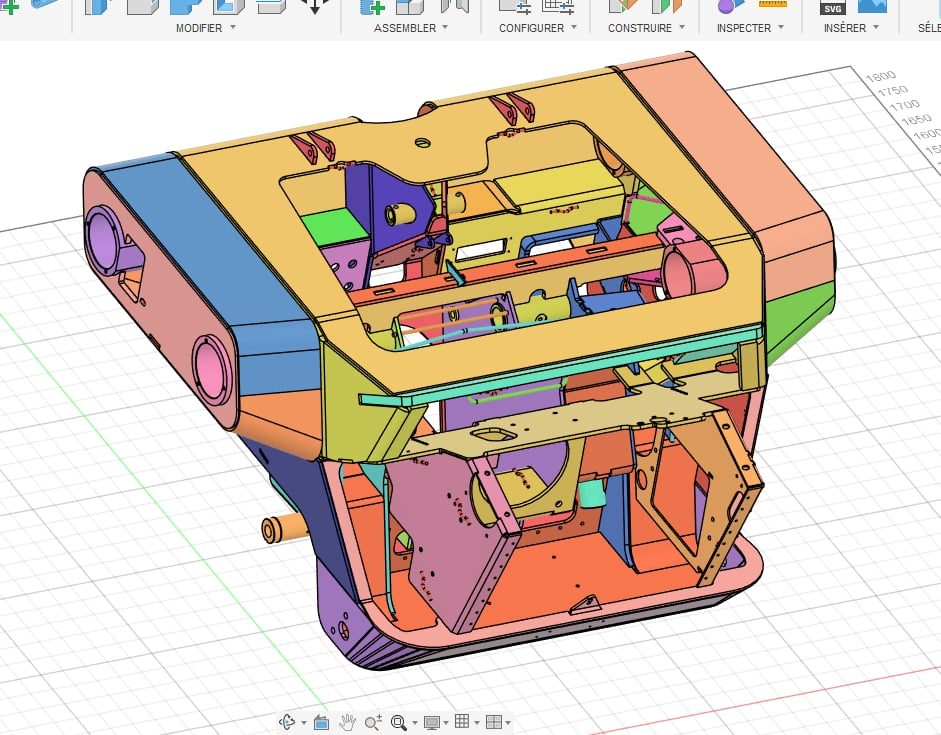
Welded chassis, adjustable track width, 3-point hitch and floating hitch, 540 rpm PTO, steering and hydraulic power unit: a complete agricultural machine whose machined, welded and painted chassis costs €7.5/kg. Read the TOOGO case study.
Sectors
Agricultural and vineyard machinery, construction and material handling equipment, landscaping machines, industrial equipment and professional tools. Our engineers come from companies including HYDAC, KUHN, PELLENC and ALTEC, and our machine operators bring hands-on field knowledge.
Frequently asked questions
What does a special-purpose machine engineering firm do?
It designs, for a manufacturer, a machine that is not available off the shelf: feasibility study, architecture, drawings, schematics and software, then prototype and testing. SIZA Engineering covers all of it with a single team and builds the prototype in its own workshop.
How much does it cost to develop a special-purpose machine?
It depends on the complexity. We quote each phase separately, starting with a feasibility study lasting a few weeks. As a benchmark, TOOGO, a 3-ton autonomous electric robot, was developed from a blank sheet to pre-series for €1.1M.
How long does it take to develop a special-purpose machine?
The timeline depends on complexity and is estimated phase by phase from the feasibility study onward. TOOGO, a complete machine with autonomous navigation, took under 4 years from blank sheet to pre-series.
Can you take over an existing machine?
Yes: upgrades, electrification, robotization or redesign of a machine in service, with reverse engineering of the existing machine if needed.
Do you build the prototypes?
Yes. Parts are made and assembled in our workshop, and the machine is then tested on benches and on our private test ground.
Do you take compliance into account?
The Machinery Directive, functional safety, EMC and the standards specific to your sector are built in from the architecture stage.
Do you design agricultural machinery?
Yes, it is one of our core areas. Our reference is TOOGO, a 3-ton autonomous electric tool carrier with a 3-point hitch, floating hitch and 540 rpm PTO, designed and built by our team.
Let's talk about your project.
A first 30-minute call with a technical lead, with no commitment.